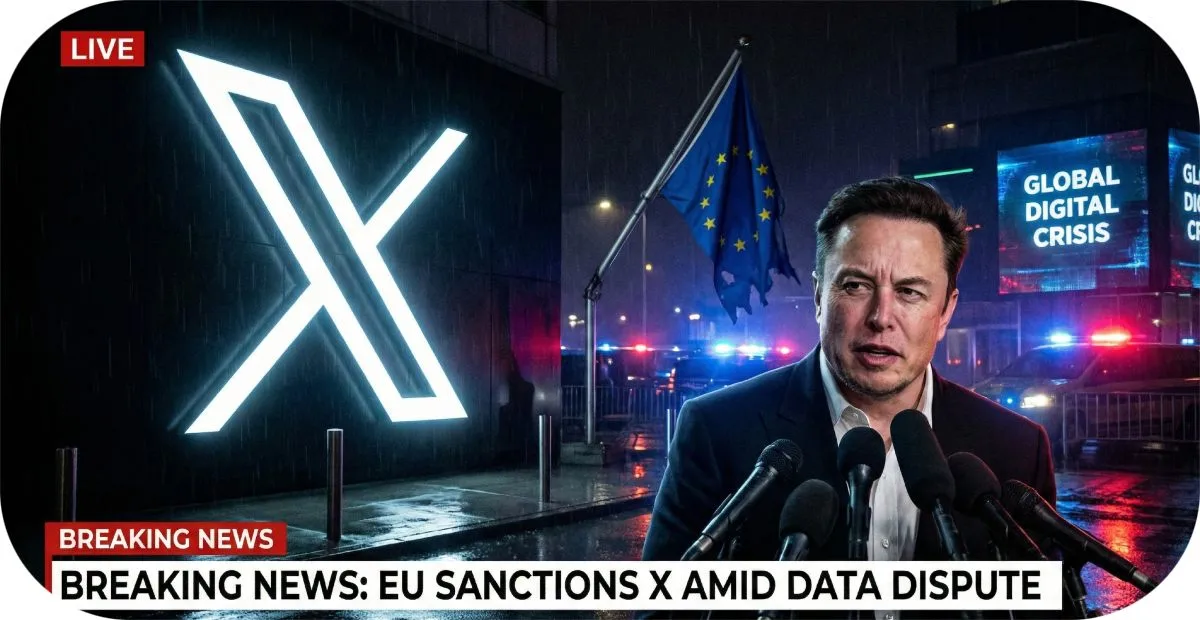
Imagine waking up to find that your social media platform — built on the promise of free speech — has just been hit with a massive fine by a powerful foreign authority. That’s exactly what happened to Elon Musk this week. The European Union has slapped X (formerly Twitter) with a whopping $140 million fine for alleged violations of the Digital Services Act (DSA).
This isn’t just a financial penalty. For Musk, it’s an ideological battle — one that has now led him to openly question the very future of the European Union itself. From electric cars to space rockets and now free speech online, Musk’s journey has always been dramatic. This latest clash shows how innovation and regulation are once again on a collision course — and the world is watching closely.



In this report, we break down what led to the fine, Musk’s fiery reaction, how the US responded, and what it all could mean for the future of tech and free speech.
What Triggered the $140 Million Fine?
The action was taken under the EU’s Digital Services Act, a strict law introduced in 2022 to regulate big technology platforms. According to EU regulators, X failed to meet the law’s requirements in three key areas.
First: The Blue Checkmark System
Earlier, the blue tick symbol stood for verified authenticity. Under Musk, it became a paid feature. EU officials called this practice “misleading,” arguing that users may wrongly assume paid accounts are trustworthy — increasing the risk of scams and fake content.
Second: Advertising Transparency
The DSA requires platforms to clearly show who is paying for ads. Regulators said X’s ad database did not provide enough searchable or transparent information.
Third: Data Access for Researchers
Under the law, platforms must share public data with researchers studying societal risks. The EU claims X blocked this access, violating the rules.
As a result, regulators imposed a €120 million fine (around $140 million). EU tech chief Henna Virkkunen said the decision was about rule enforcement, not censorship:
“If you follow the rules, you don’t get fined.”
Musk’s Fierce Reaction: From Anger to ‘Abolish the EU’
Elon Musk reacted almost instantly. Posting on X, he dismissed the decision with a blunt response:
“Bullsh—.”
But his anger didn’t stop there. In a series of tweets, Musk escalated his criticism and questioned the legitimacy of the EU itself.
“How long before the EU is gone?” he posted, adding the hashtag #AbolishTheEU. He described the EU as a “bureaucratic monster” and said he supports Europe — but not what he called its “unelected institutions.”
Musk argued that power should return to individual nations and that freedom is being strangled by excessive rules. He even supported calls to abolish the European Commission, labeling it a “totalitarian institution.”
For many of his followers, Musk’s reaction turned a regulatory penalty into a full-blown free speech debate.
Free Speech vs Regulation: The Core of the Clash
At the heart of this controversy is an old global argument:
How much should governments control online speech?
The EU says the DSA is designed to protect users from hate speech, scams, and misinformation. Musk, however, believes such laws quietly turn into systems of censorship.
X has already been under several EU investigations since 2023, including checks on hate speech and misinformation during global crises. Musk earlier claimed the platform rejected a “secret deal” to quietly censor content.
Supporters also point out that TikTok avoided a fine by improving its ad transparency, raising questions about why X was singled out.
US Slams EU Over X Fine
The fallout didn’t stay limited to Europe. Several top US leaders strongly criticised the EU’s move.
- Secretary of State Marco Rubio called the fine “an attack on American tech platforms.”
- FCC Chairman Brendan Carr accused the EU of punishing success.
- Vice President JD Vance warned European officials to stop targeting US companies.
With Trump allies backing Musk, the issue has now taken on a major geopolitical dimension.
Musk Questions the Very Future of the EU
Musk’s strongest statement was his call to abolish the European Union altogether. He argued that Europe should return to a system of independent, sovereign nations.
The EU, created after World War II to promote unity and peace, is now facing growing criticism from various political groups across Europe itself. Musk also suggested that EU leaders should be directly elected instead of being appointed.
Hashtags like #AbolishTheEU are now trending, supported by several European nationalist leaders.
What This Means for Big Tech and Users
This case sets a powerful example. Under the DSA, fines can reach up to 6% of a company’s global revenue, meaning future penalties for companies like Meta or Google could run into billions.
For users, the impact is mixed. While safety and transparency may improve, many fear tighter controls could also limit free expression.
X has been given 60–90 days to fix the violations or face further penalties.
A Personal Blow for Musk and Global Innovators
For Musk, this fine is not just about money. It is about control over innovation and speech. Supporters see this as yet another example of governments trying to restrain disruptive technologies.
The emotional reaction from his followers reflects a broader frustration felt by entrepreneurs worldwide when rules slow down new ideas.
Global Reaction: Divided World
Reactions across the world remain sharply divided.
- Many in Europe call the fine a victory for accountability.
- Supporters outside the EU see it as jealousy over American tech dominance.
The debate between #FreeSpeech and #DSARules continues to dominate online platforms.
What’s Next for X?
Musk’s vision for X is based on “absolute free speech.” The big question now is whether he will:
- Fully comply with EU demands
- Appeal the fine
- Or continue to challenge the system publicly
With investigations still ongoing, more penalties are not off the table.
Conclusion
The $140 million fine on X is far more than a legal penalty — it marks a critical moment in the global fight between free speech and digital regulation. Elon Musk’s aggressive response, including his call to abolish the EU, has turned this into a worldwide political and ideological storm.
While the EU insists it is protecting users, Musk and his supporters see it as an attack on innovation and freedom. With strong reactions from the US government and rising political pressure in Europe, this case could reshape how the world regulates Big Tech.
One thing is clear:
This fight is not ending anytime soon.
